
Wales. A place where sheep outnumber humans 3:1, and 230 square miles of lush countryside soak up 173 rainy days a year. The journey is part of the experience, so expect your drive (or indeed helicopter ride) to Ynyshir to be an idyllic one; the pilgrimage provides a picturesque amuse yeux of rolling hills, lush valleys and all manner of free-range beasts, blissfully unaware of what chef Gareth Ward has in store for them.
13 years into his tenure, Chef Ward has remodelled the former country house hotel into a gastronomic destination, offering a 30-course Noah’s Ark of ingredients accompanied by open kitchen and live DJ. Sure, Gareth Ward has attained two Michelin stars. But more importantly he has earned a reputation for being one of very few visionary chefs in the UK, delivering a menu that follows his own stylistic principles.
The tasting takes place in a single sitting; a room of 20 dining disciples are fed in unison. I enjoyed this ritualistic quality, a collective experience that started with complimentary Champagne in the waiting area adjacent to the restaurant. Then arrives the first sip of Ynyshir: duck broth with spring onion. The restaurant uses Silverhill farm ducks – a unique breed that is exclusive to a single farm in County Monaghan, Ireland. The sincerity of the presentation made the eating even more miraculous; this was a broth so remarkable that I put it down and stared at it for a while, pondering its secrets. I was wowed. Fabulously savoury, intense and thrilling – the essence of duck suspended in a potent dashi.
I could have died happy in this moment, but instead wiggled into one of the restaurant’s floor-length fur coats and headed into the night for a brief visit to the Himalayan salt chamber, where the meats, fish and poultry on the menu are aged. The salt draws out moisture, leading to the intense flavour and rich meatiness characteristic of Gareth Ward’s style. We head back inside, where red sea bream with white soy and wasabi oil is waiting patiently and at perfect temperature. The ingredient sourcing is scrupulous – the best of everything, from wherever in the world they can get it. The menu reads like a who’s who of the world’s best producers. On the red carpet: N25 Caviar, Ethiopian coffee (exclusive because they bought the whole farm), A5 wagyu, fresh wasabi, rice vinegar from the 130 year old Ilo Jozo brewery, and those impressive rare-breed ducks.
Gareth Ward is producing one of the best and most exciting fine dining experiences in the UK
Whilst the menu is relentlessly full fat, the garnish and service are refreshingly lean. Most of the courses arrive without tedious storytelling (service is extremely well informed, friendly and minimal); dishes are instead explained simply as whatever chef Ward thinks tastes good, with whatever he thinks goes well with it. For example: a “triple fat bomb of confit fatty tuna with Novo Picual olive oil” (a notably grassy and spicy oil, that’s as close to a vegetable as you get in this dish) is as blissfully naked as a plate can be, and yet I didn’t feel cheated. The fish melts on the tongue, and a utilitarian thumb of sourdough (one of only two small morsels of bread on the menu) is provided to soak up the remaining oil.
Complexity is ramped up for the scallop chawanmushi – a textural delight – silky and creamy Orkney scallop and sweet dashi on a warm custard of technical perfection. Wagyu is used liberally throughout the menu; not content with the tenderness of the very best A5 wagyu, Gareth Ward further insists on only using female cows. There’s method in the meticulousness: female wagyu have a hormonal advantage that makes them softer in texture, with a more consistent, finer marbling. Their fat, higher in oleic acid, melts at a lower temperature, ensuring the most buttery and luxurious mouthfeel. The apex of this fat-forward approach is the fatty tuna wrapped in A5 wagyu, with some pickled ginger and wasabi mercifully thrown in. Wagyu appears later in a different incarnation: with daikon and cured egg yolk. Like most of the courses it looks unassuming: a chunk of beef cap, a spoon of sauce, a mound of Daikon Oroshi; a simple and usually refreshing condiment, made rich with fatty egg yolk. A third wagyu serving comes as a beef broth with shiitake mushrooms and truffle: scented like a Piedmontese forest and rich in umami. It’s clear that the flavours and ingredients of Asia have heavily impacted the menu, but in ways that are unorthodox and surprising, like the fourth wagyu offering: “That First Bite” – designed to evoke memories of your first bite of cheeseburger. A wagyu patty, gherkin-esque pickles and sourdough mayo make for a phenomenal mouthful, a bit of fun, but well considered and perfectly executed.
Hold on, there’s more wagyu – an A5 curry with beef dripping sauce, because if you hadn’t quite understood the brief, fat at Ynyshir is not only a means to an end, but also an end in itself. Fat here can be a main protein, a seasoning, a condiment and a garnish. You may find your fat has been cooked in fat, aged in fat, wrapped in fat, or that your scallop arrives under beef fat gravy. Your cod may arrive in smoked butter and pork fat, or as in the case of this two-spoon curry, your delightfully fatty beef may be further enriched with yet more fat. He can’t help himself! The spicing is confident and intelligent throughout the menu: there’s a tongue-tingling laab with a reluctant bump of sticky rice, Dyfi shrimp (local to the restaurant) with braised aubergine and peas in a fragrant, delicately balanced Thai green curry. There’s an utterly indulgent lobster claw with satay sauce sharp lime zest and mischievous sprinkle of candied peanuts, or Singapore style chilli crab with chilli crab ketchup and spicy togarashi. I sensed we were eating the things Gareth Ward would himself choose from a menu, reimagined through the prism of his bold and reduced cookery style.
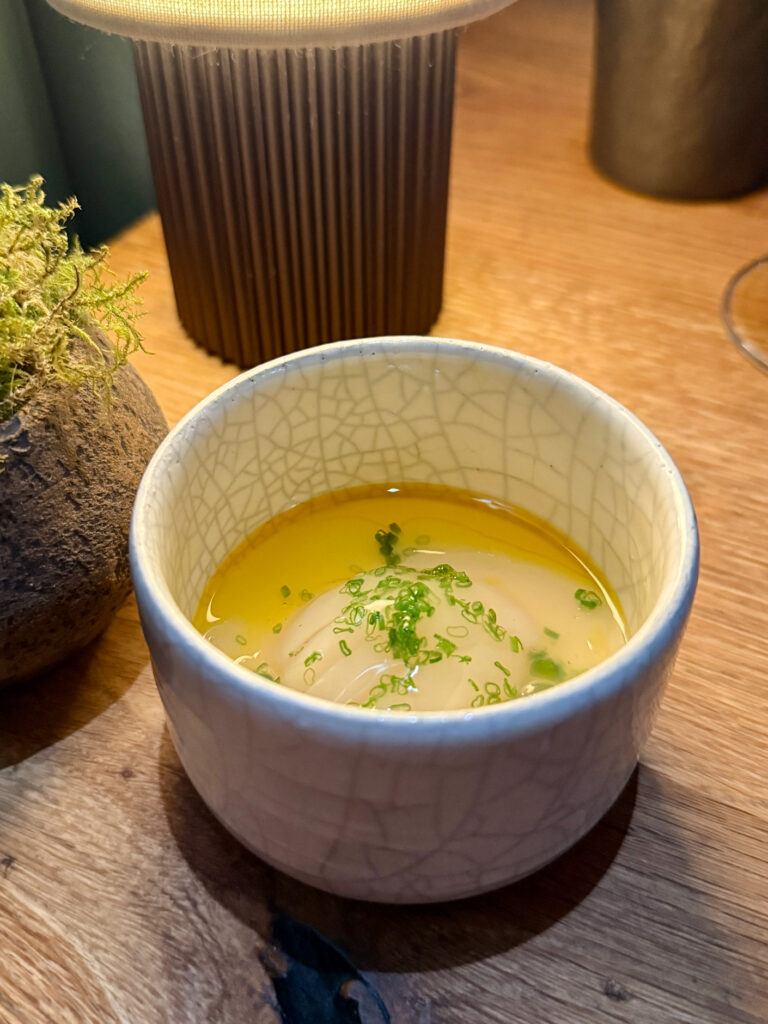
Duck broth with spring onion
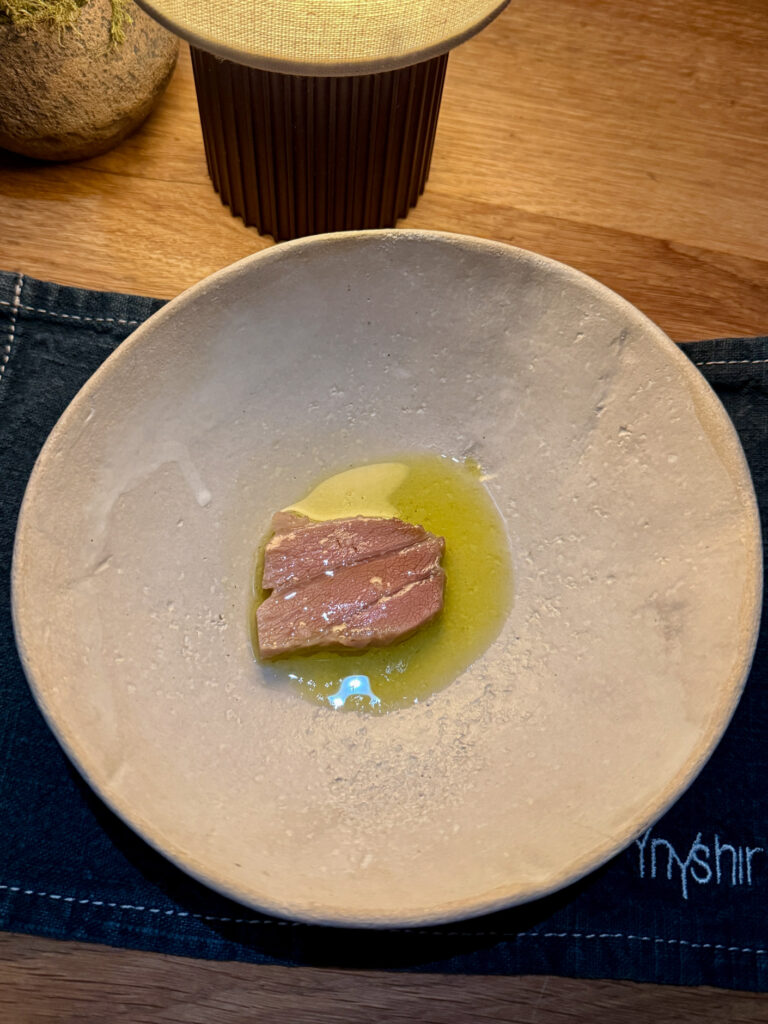
Akami with Novo Picual olive oil and jalapeño
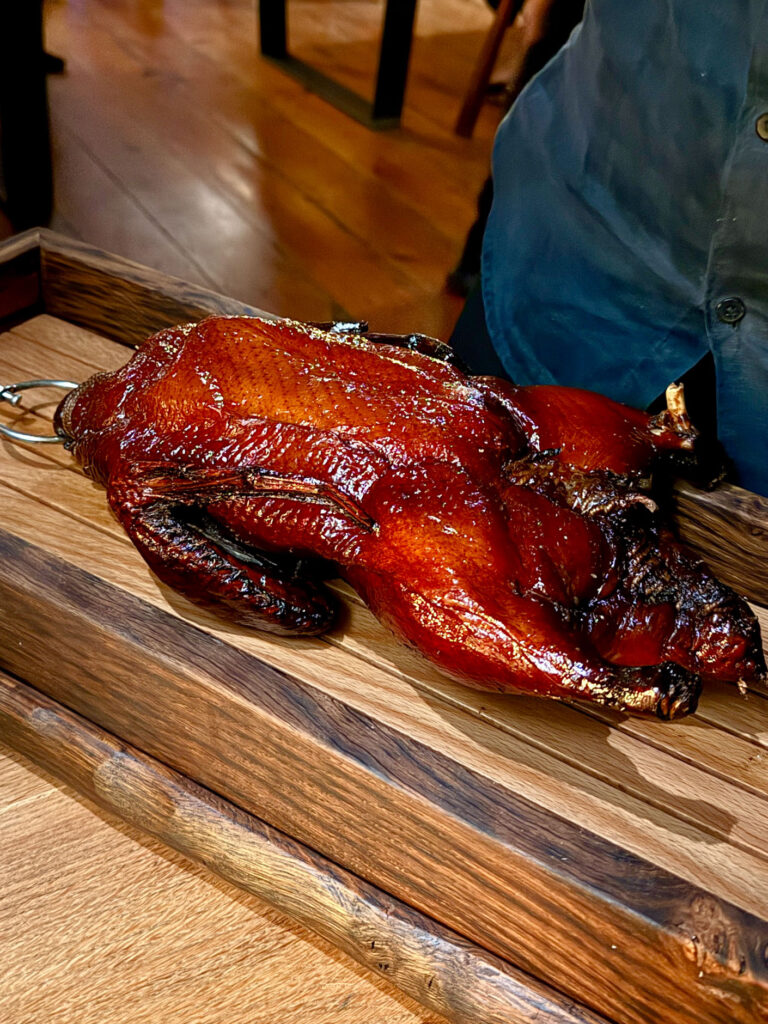
Roast Silverhill Farm duck
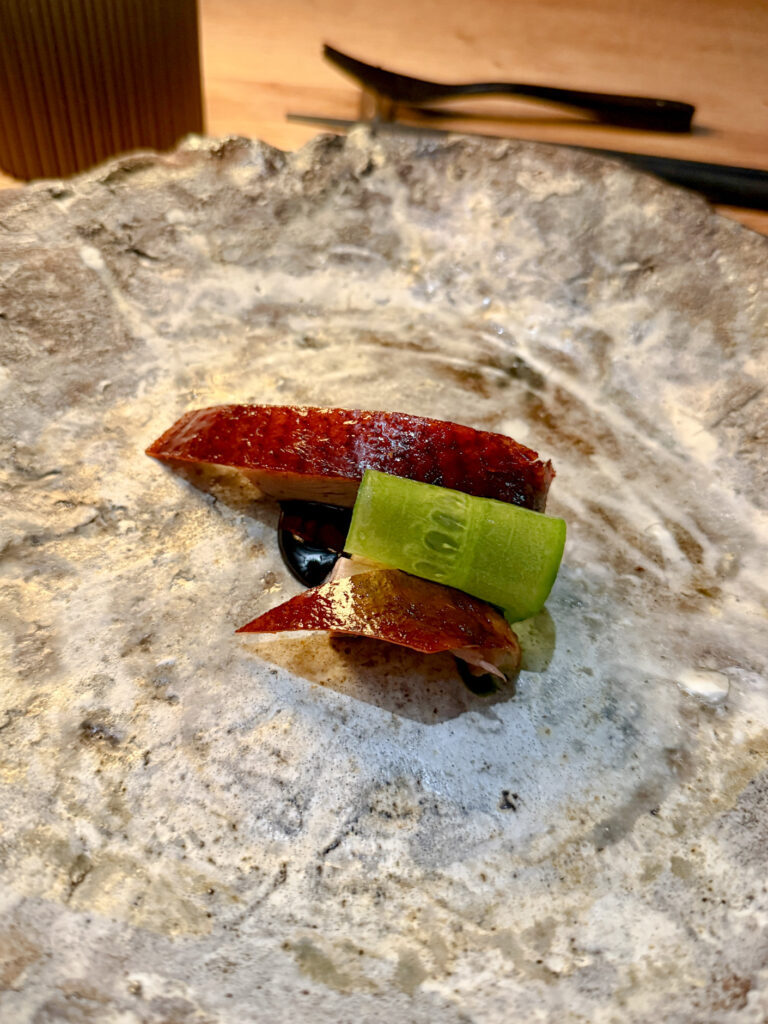
Roast Silverhill Farm duck with hoisin and cucumber
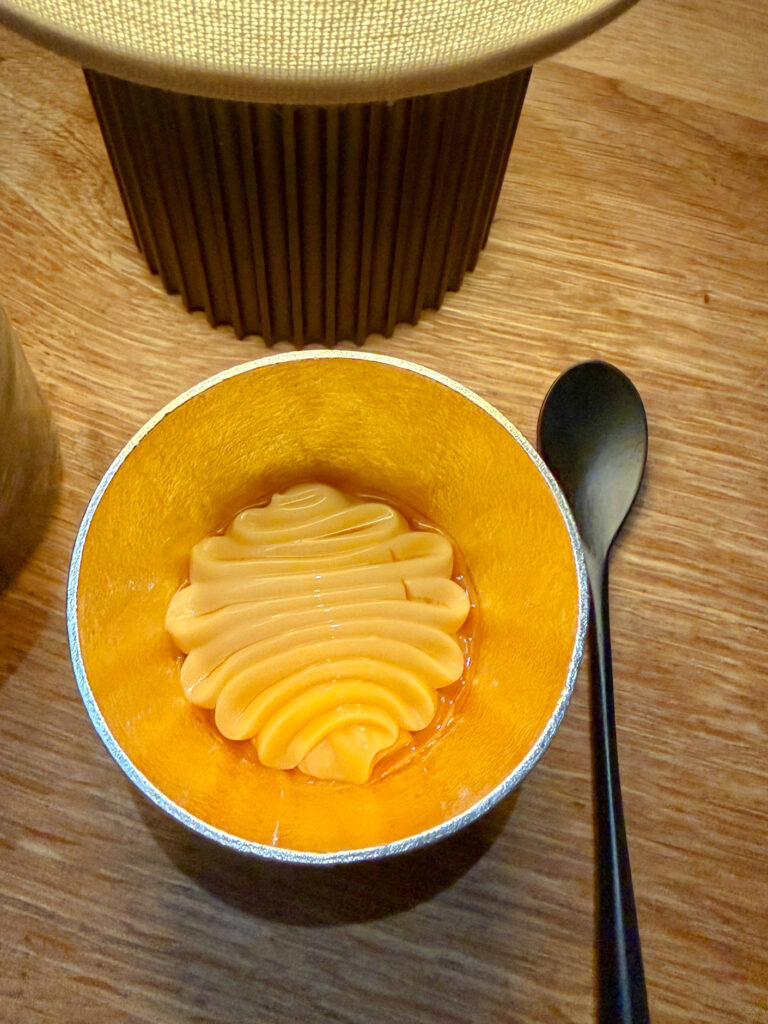
Duck egg custard with peach liqueur
Working through the menu, I felt in awe of the Gareth Ward method. It’s fiercely utilitarian: you’ll find no wafer thin tuiles or artful blobs of puree here. Instead, everything on the plate has an irreplaceable role. This mission is further compounded by the carefully chosen aesthetics. Organic shapes and muted tones, complement the fuss-free food. The in-house blacksmith makes many of the knives, plinths and prongs that assist your dining, there are no tablecloths or clever cutlery designed to make a fool of you. Yes there’s a DJ, but even this feels purposeful: if you were cooking for 5 hours a night in your own gaff, why play music in flat mp3, when your favourite songs could instead be delivered in voluptuous analogue? This is the essence of Gareth’s approach: to consider what the best possible product is, and what the tastiest way to serve it might be, without considering budget, airmiles, or what the non-believers think.
Speaking of non-believers, it would be remiss of me not to mention the controversy surrounding Ynyshir’s recent One Star hygiene rating. Whilst some critics claim that Michelin Star restaurants should be exempt from the food hygiene standards that even burger vans adhere to, I’m of the belief that the same rules should apply to all (not to be confused with the belief that all the rules are “fair”). A 1/5 score conjures images of infestations and mouldy food, but in reality restaurants can receive low hygiene ratings for sins which may include missing paperwork or cracked floor tiles. Allowances have to be made for the realities of preparing fresh foods in rural environments (I once visited a famous Basque steakhouse that had a serious issue with flies, despite the dining room and kitchen being immaculate; such is the nature of preparing raw meat on a warm day in an agricultural setting). It’s also worth noting that creative chefs will often use novel processes that don’t fit comfortably into tick boxes. More can be done to understand these methods before judging them to be unsafe. With all that said, it appears there were shortcomings at Ynyshir. These were all resolved by the time of my visit: the restaurant and accommodation were of a higher standard than I had imagined, and were spotlessly clean.
Anyway, I must tell you about the duck. The Silverhill Farm is secretive about what exactly makes these ducks taste so good, but what we do know is the farming is very selective and the ducks are purpose-bred for flavour. Presented tableside is the whole roasted duck in all its glossy glory, the product of a low, slow cook, after two weeks ageing. The fat is rendered to the point of stained-glasslike perfection, and seasoning is minimal – a little salt, a little hoisin, and a barely-there ribbon of cucumber, nods to the Beijing classic. This must surely be one of the best ways to appreciate the ingredient; I wish there was more of it.
Whilst nobody could claim the tasting menu (£390/pp) is a bargain, given the quality of ingredients, and the unique nature of the restaurant, I did feel the experience was worth it
Whilst this is very much a manly affair, little whispers of femininity punctuate the menu: a delicate ginger shaved ice disappears in a moment and cleanses the palate, a barely set milk jelly topped with coral pink rhubarb tickles the inner child. It wouldn’t make sense if this masculine feast ended with macarons, and so it doesn’t. Desserts are less thrilling than the savoury courses, but still remain committed to the idea: lots of fat – this time mostly in the form of dairy: miso ice cream melts into sticky toffee pudding under medjool date sauce. My favourite dessert was the duck egg custard, which has remained on the menu for a decade. I’d be lying if I said was as smooth as butter; it was in fact smoother that butter, and topped with not so much a dash, but a full scale sprint of peach liqueur. By this point in the meal the experience, the music, your waistline, and your ability to hold your liquor, have all reached critical mass. Suddenly, “Smalltown Boy” by Bronski Beat began playing, and an inebriated diner broke ranks and began dancing in the dining room. It was strangely moving. I couldn’t name another restaurant of this stature where such a thing could happen.
Dining here isn’t cheap. Still, I was pleased to find that the menu offered no supplements. This has become all too common: some fine dining menus double in price once you allow for supplements (the process whereby they tempt you in with a reasonably priced menu, then bully you into paying extra for caviar, truffle and whatever else). I appreciated Ynyshir’s inclusive approach, which ensured every diner had a top tier experience that included generous helpings of luxury ingredients. The wine list is also surprisingly fair – glasses of sake start at £7.50, glasses of red wine start at £8. A decent bottle of red – a 2016 Chateau Musar, for example, that retails for £55 – will set you back £115, and a 2012 bottle of Billecarte-Salmon Champagne that retails for £170-200 is on their wine list for £325. Whilst nobody could claim the tasting menu (£390/pp) is a bargain, given the quality of ingredients, and the unique nature of the restaurant, I did feel the experience was worth it.
Man has been cooking on fire for 800,000 years; it’s nothing new. And yet in the hands of Gareth Ward, fire-cooked proteins are made delicate and indulgent. My fears of being served charred bits of lamb in a nightclub environment were not realised. Instead, a carefully curated playlist, a menu of silky textures, surprising complexity, and intensely saturated flavours. It’s easy, with hindsight to say I’d have liked an additional vegetable or two, but at the time I had no such desires. Ynyshir is truly unique – this is not a restaurant one could easily say reminds you of some other thing you’ve experienced. Gareth Ward is producing one of the best and most exciting fine dining experiences in the UK, one that is worth journeying to the end of the earth for. Your pilgrimage will be well rewarded, if you dare.
Ynyshir Restaurant and Rooms
Eglwys Fach
Machynlleth
SY20 8TA
March 2026