Unless you’ve been living under a giant scallop shell or you’re the UK government, you can’t be unaware of the current hospitality crisis. To sober us up after Christmas, The Caterer recently reported that four hospitality sites closed every day in Q4 2025. And while you would be forgiven for thinking affluent areas like Kensington and Chelsea are immune from rising costs and difficult landlords, Le Colombier on Dovehouse Street served its last crème brûlée in December 2025.
Restaurants like Le Colombier are so ingrained in their community they can never really be replaced, though a strong contender for a go-to French neighbourhood bistro in nearby Kensington has gradually emerged in the last couple of years, attracting effusive praise from Nigella Lawson and gaining an entry in the Michelin Guide. A trip to the Design Museum across the road provided an opportune moment to see what La Palombe is all about.
I already know the venerable Il Portico just a few doors down (who doesn’t?), but La Palombe is a much newer venture for Il Portico’s third-generation owner James Chiavarini (and technically it’s a half-sister restaurant as it’s co-owned with chef Jake Leach and has its feet firmly in France rather than Italy). And this again illustrates how volatile the industry is right now: Chiavarini first made it a wine bar called Pino before a necessary (but delicious) “pivot” to a Pays-Basque bistro.
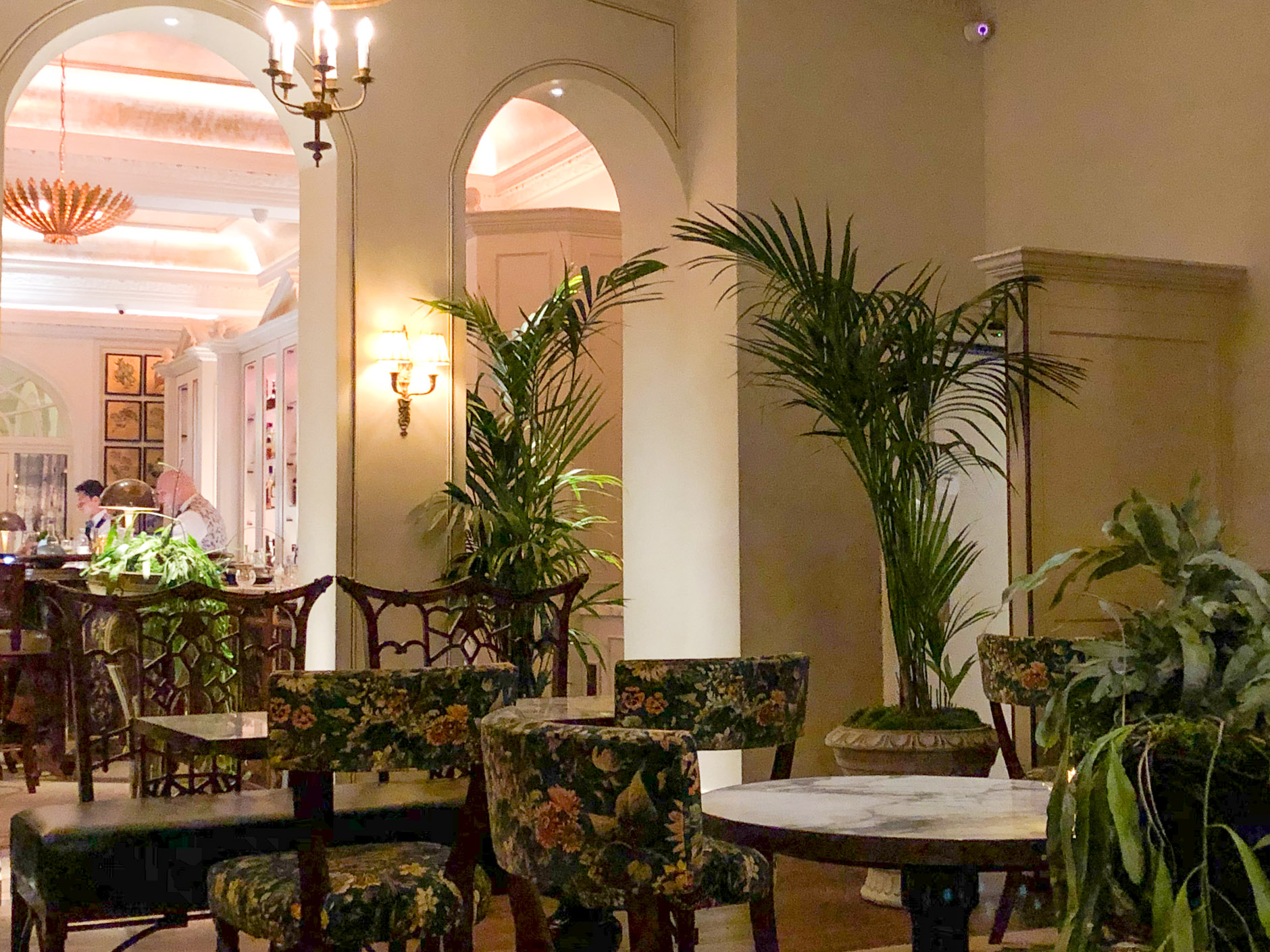
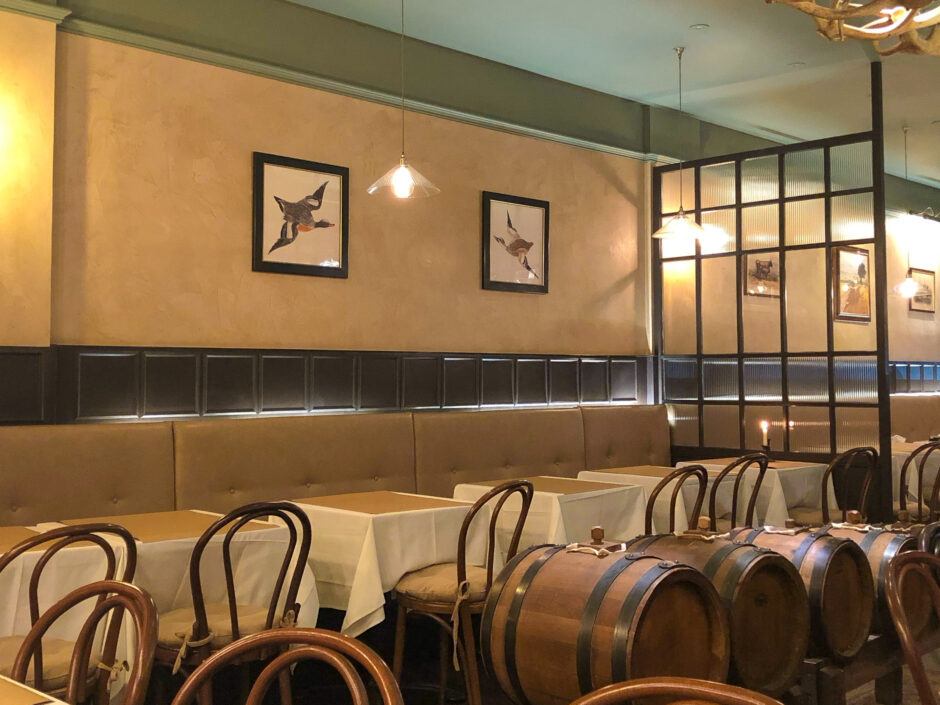
But a lovely bistro it is, with a gleaming bar perfect for a curtain-raising Vesper or their French Negroni (made with Courvoisier instead of gin), pictures of birds in a nod to the restaurant’s cuisine (“palombe” is also French for wood pigeon) and the flattering glow of candlelight. It was also pleasing to see Mr Chiavarini himself (much like Jeremy King or Otto Tepasse, he’s a hands-on restaurateur who greets guests instead of poring over spreadsheets; he is also a hunter-gatherer extraordinaire, shooting a lot of the game himself or foraging with his trusty four-legged sidekick called Alba).
Perhaps what is most impressive about La Palombe is its apparent simplicity yet it’s clear every detail has been thought through carefully
Even the muted earthy tones of the walls subtly evoke Périgord with hues of truffle contrasting with walnut – a dual tonality that is essentially the same colour palette as a pain au chocolat. Overall, it exudes a rustic, country feel without trying too hard.
The same goes for the food. There are no culinary bells and whistles here, just a wood grill and superbly-sourced ingredients. Jake Leach, who was formerly head chef at three-starred The Ledbury and now oversees said grill, hasn’t succumbed to any cheffy showing off here; nonetheless it’s clear that his impressive background is a huge asset for this restaurant. The ingredients are in safe hands – I could tell from the perfection of the confit duck alone.
But first, braised venison croquettes (not bad value at £5 a pop). These were perched on a burnt leek mayo, texturally pleasing and deeply flavoursome. I suspect, as venison is lean, the braising process really did the heavy lifting here but the results were excellent, with no hint of dryness, while the outer crater of the croquettes had the requisite crunchiness.
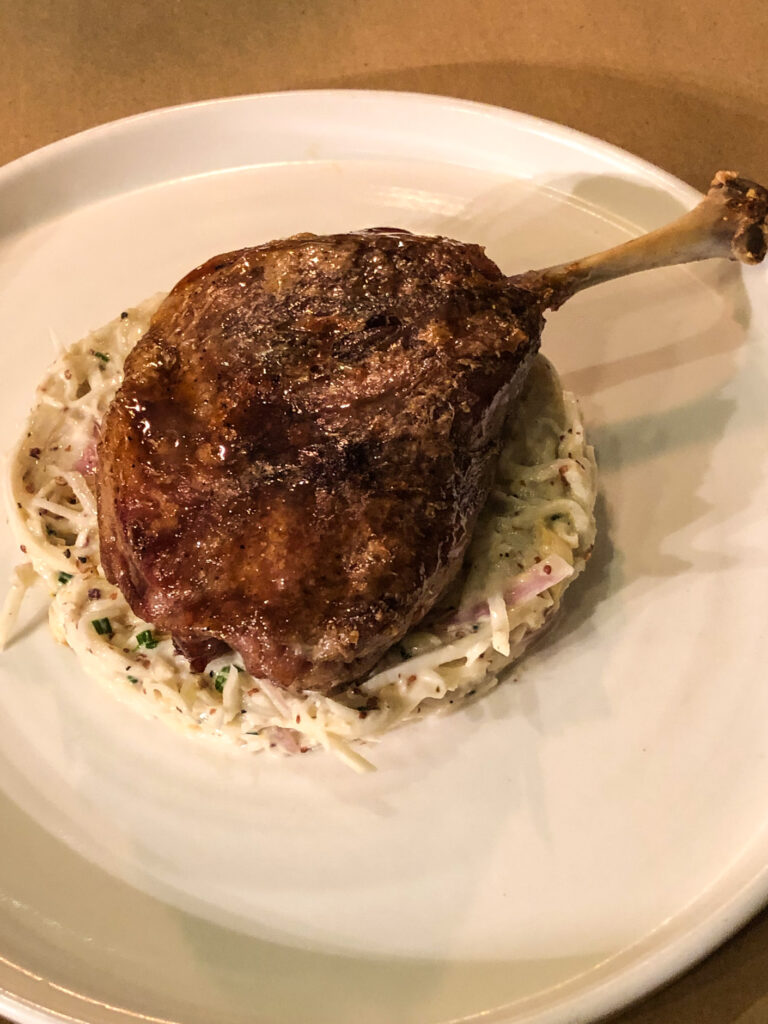
Confit duck with celeriac and chicory remoulade
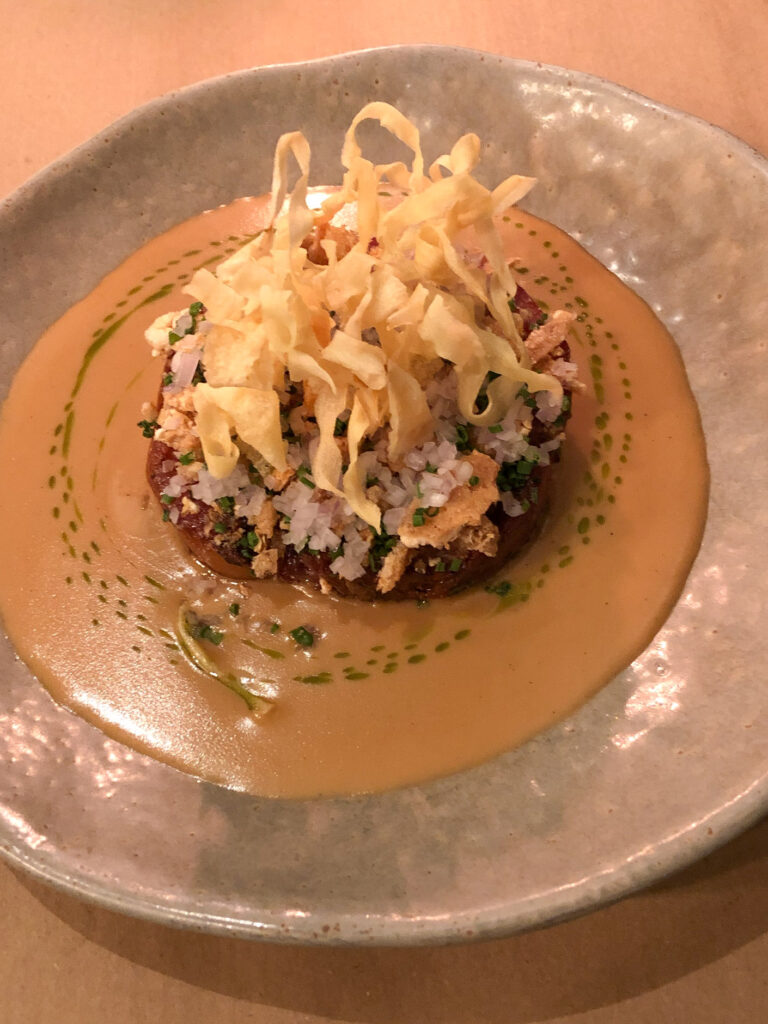
Confit Cumbrian pork belly
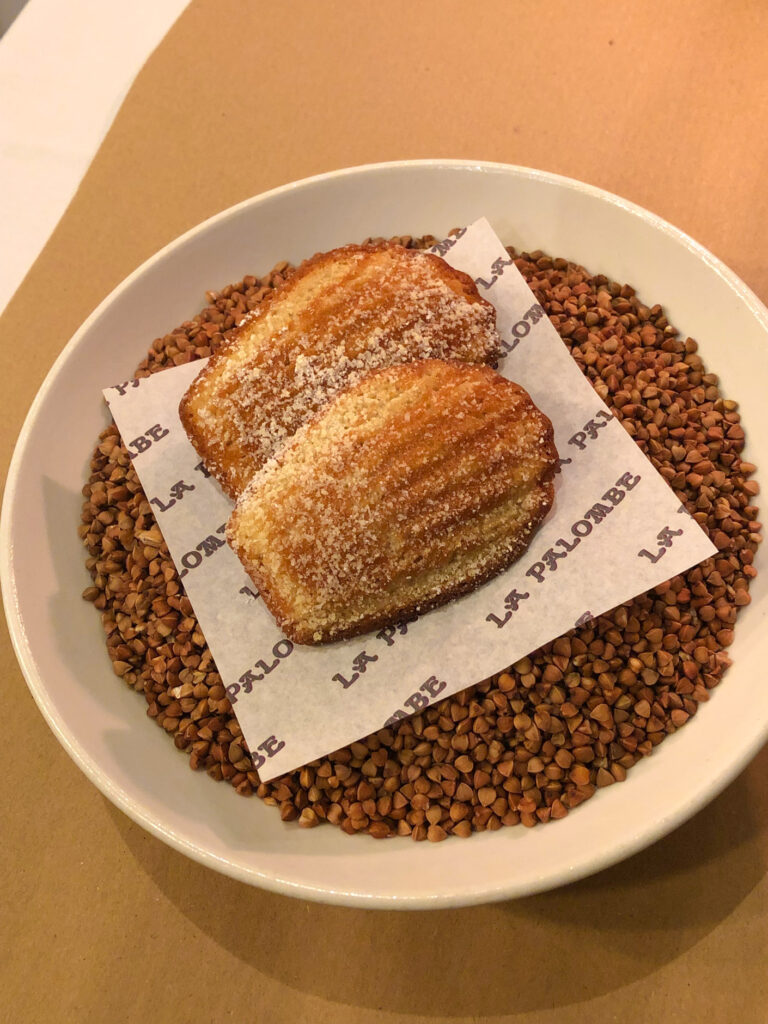
Madeleines
A boudin noir with fried Clarence Court egg and crackling (£15) seemed like a posh breakfast to me rather than a starter, but to hell with it. This was yet another celebration of great produce, unashamedly rich and hearty.
Then that confit duck (£15). You really have to admire the chops of any kitchen that just presents a bird leg on a disc of celeriac and chicory remoulade. With nowhere to hide, and no sauce to mask any embarrassment, it’s all about the cookery. It was another study in less-is-more and another triumph: the skin crispy, the meat tender thanks to the slow-cooking in its own fat, and the remoulade providing a vegetal counterpoint – creamy and with just the right amount of mustardy swagger.
There was only one way to go after that confit experience and that was even more: the confit Cumbrian pork belly, slightly more substantial a portion at £34, also showcased that judicious use of fat, with seasonal Jerusalem artichoke for sweet nuttiness and a potpourri of crackling haphazardly arranged on top. The nearest thing to fancy presentation here is a split oil but it’s an admirable style similar to the quiet confidence of, say, Andrew Edmunds or Bouchon Racine: just let the ingredients be.
Stuffed as a taxidermist’s chou farci by this point, the chocolate tart or fig leaf crème brûlée weren’t really in prospect on this occasion. However, freshly-baked madeleines – as good as The French House in Soho – were just the ticket.
All of this was enhanced further by attentive and friendly service, and a short, mostly Gallic wine list (mark-ups are consistent with the London average). I had virtually no ‘notes’ from this experience, save that the Vesper martini could have been colder and drier, and there was a teeny bit of upselling having already said “no” to side dishes, but its strengths outweigh these little pet peeves. I happily paid the bill and bounced over to Amaro for a digestif (incidentally, there are many great bars nearby, including Sprout, Twice Shy and The Stables Bar, so a Kensington session with La Palombe as the fulcrum just writes itself).
La Palombe’s own website says, with no whiff of hubris, it is “quietly gaining momentum”. A lot of the best restaurants are more tortoise than hare, marinating and maturing over time, unlike certain brash newcomers (often chains or US imports or both) who bulldoze Instagram with their AI-generated marketing campaigns, being merely a victory of prompt engineering over taste. Perhaps what is most impressive about La Palombe is its apparent simplicity yet it’s clear every detail has been thought through carefully.
It is an unassuming joy. Long may it last.
267 Kensington High Street
London
W8 6NA
February 2026