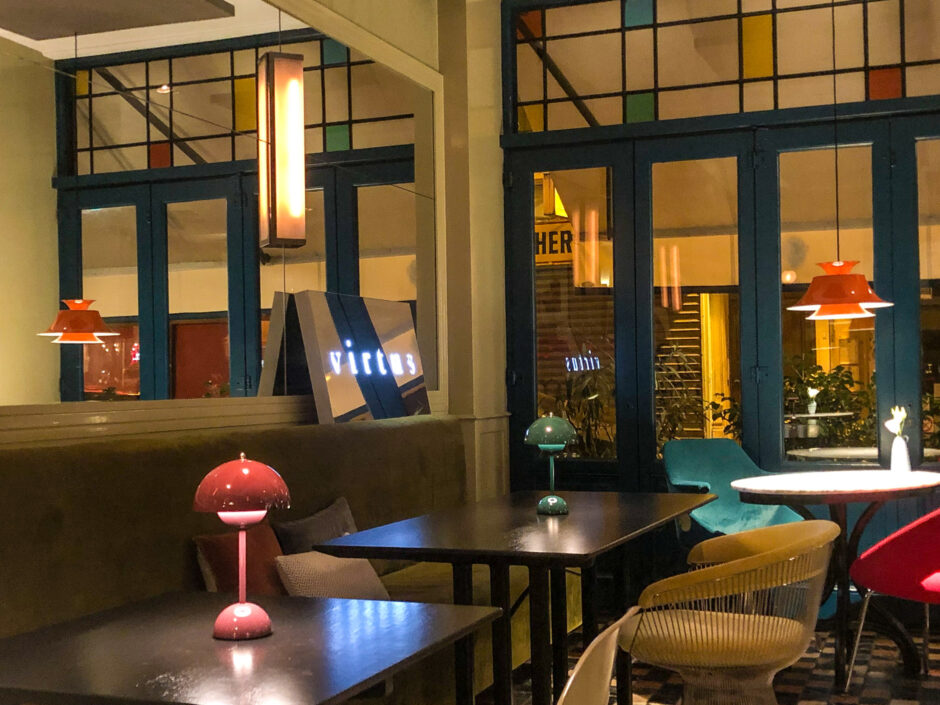
The 12th arrondissement may not be very high on most people’s agendas when visiting Paris, even if walking along the elevated Promenade Plantée. A lot of this area is residential, but it’s also one of the largest and most diverse parts of the city. From Bastille through to the Bois de Vincennes on its eastern edge, this is an enlarged fatty liver of an arrondissement, though on the food front more attention tends to be paid to its northern neighbour and the uber-cool (still cool?) Oberkampf. Admittedly, whenever I’m killing time in Gare de Lyon (in the heart of the 12th) I’ve tended to make a virtue out of necessity and dined at Le Train Bleu between TGV connections (naturellement). But venturing out to the food market in Place d’Aligre, I was pleased to finally broaden those horizons and discover Virtus.
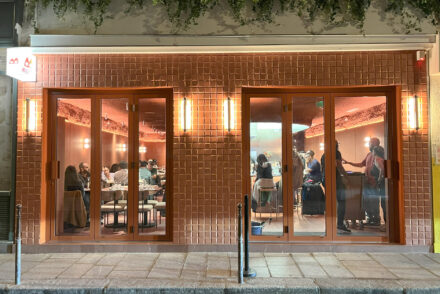
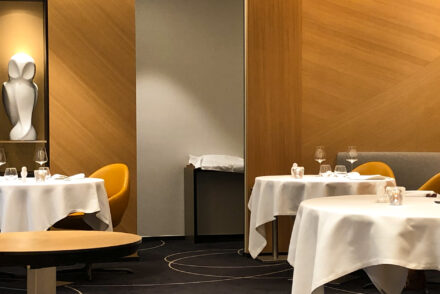
Virtus is a 12th arrondissement restaurant that seems to hide in plain sight (despite its bold façade and eclectic lampshades); for some reason it’s one of those places that has just eluded me, even though it has been around for several years and has already moved on from its first iteration. This used to be La Gazzetta but became Virtus under Chiho Kanzaki and Marcelo Martin di Giacomo (both ex-Mirazur). It is currently run by Camille Gouyer (front of house) and chef Frédéric Lorimier, with design by Marcelo Joulia, an architect and art collector of all things recherché. It certainly feels more like a virtuoso’s home than a flea market, and pleasingly the tables are spaced apart liberally (rare in Paris), but when you’re given a little booklet explaining the history behind all the mismatched chairs and random objets d’art, it does set off the ‘style over substance’ alarms.
The portions are notably generous rather than dainty: this is not one of those fancy restaurants where each course has the nutritional value of a communion wafer
Indeed, there’s a lot to take in about this place before you even eat anything, including the florid menu, which only heightens the anticipation. I’ve often thought French menu language should be studied in British schools: these menus are pure poetry. Of course, many modern French restos have gone down the laconic, single-word route – a form of menu construction that’s like communicating with a grunting teenager and tends to raise more questions than answers – but Virtus seems to belong to the Baudelairean school of carte lingo.
Take this opening gambit for instance: “crudo de gamberoni et fraîcheur d’une rose glacée au corail des têtes et au citron fermenté, bouillon chaud de crevette infusé à la citronnelle et à la mélisse.” Wonderful. You could try putting that through a translation app but it would probably go on strike after the third word. Instead, just bathe in that description, especially when the server repeats it out loud. And by the way, this three-way celebration of the humble prawn lived up to its expectations, commencing proceedings beautifully with a glass of champagne and a free brioche-croissant hybrid.
Keeping with the fishy theme, next came lightly seared lisette (a young mackerel, currently scarce in north Atlantic waters) with mustard seeds suspended in vinegar and artichokes à la barigoule (a traditional Provençal way of braising artichokes in white wine), bound by a nasturtium sauce. This was intricately balanced in both flavour and texture.
Then a particularly impressive dish of flame-cooked red mullet with a solitary pomme soufflé, a luxurious sage sabayon, and a deeply rich fish bone and red wine jus for the ages. This was astoundingly good but would’ve been even better with more than one pomme soufflé (devilishly difficult though they are to make).

Red mullet
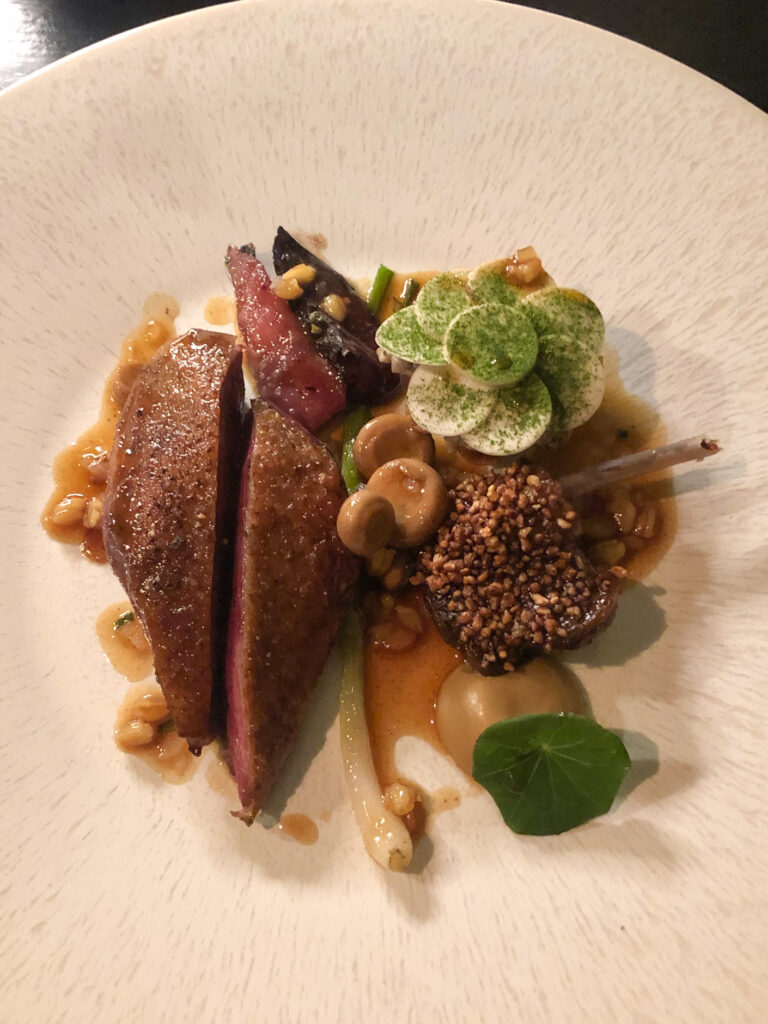
Squab
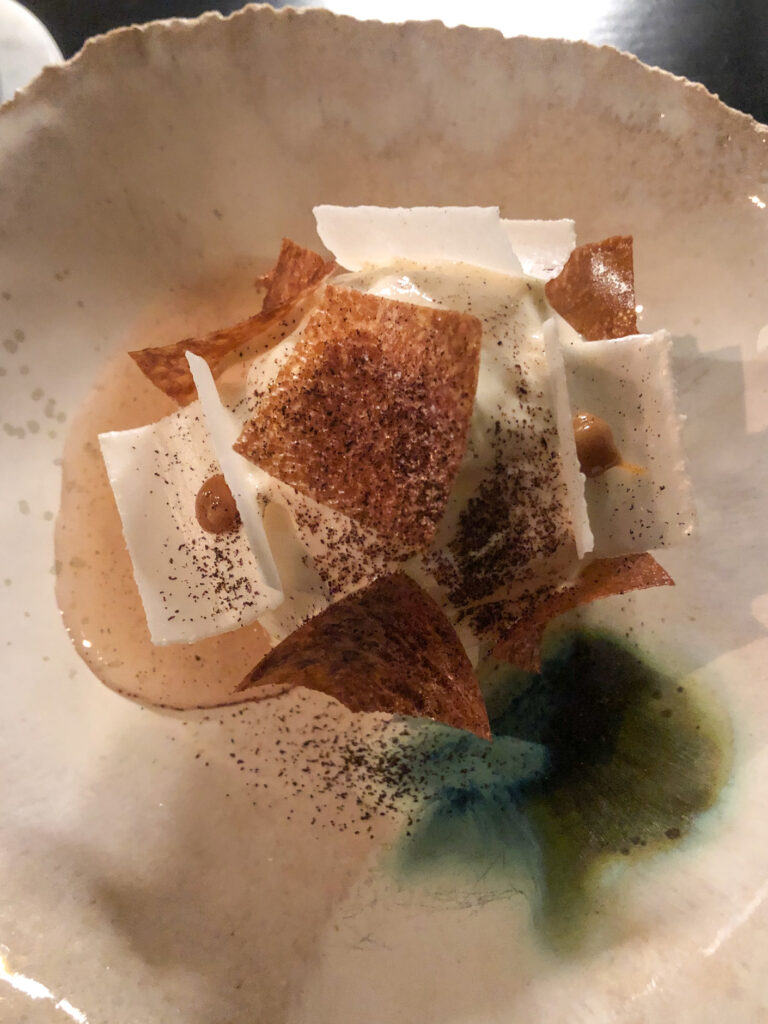
Pear
For a little theatre between the fish and meat parts of the meal, a citrus granita was topped with yellow Chartreuse, served at the table from a giant bottle (though, understandably, used sparingly, given the international shortage).
Squab, sliced open and looking like a heart, with a separate confit leg, a tarte fine of girolles, and another voluptuous jus studded with spelt, shallots and more mushrooms, was just divine, despite the crowded plating. And as with the prawns at the beginning, dessert was centred around one core ingredient – pear in this case – and elevated to something exceptional.
As the menu changes as often as government policy, this can only be a snapshot in time. But, these superb dishes – each of them pretty much faultless – were enough to tell me that this is very accomplished cooking. It certainly helped that the service was so sleek and professional too: discreet, pleasant and no tableside monologues about the life cycle of snails or the supremacy of Normandy butter.
A quick word about the pricing. This six-course feast (the “Echappée Belle”) started at 145 Euros and that was before ordering any drinks. With supplements for cheese at about 22 Euros, your wallet needs to be prepared for the thrashing it will take. But, the portions are notably generous rather than dainty: this is not one of those fancy restaurants where each course has the nutritional value of a communion wafer and you end up having an undignified emergency McDo on the way home. There’s a wine-matching option but the bottles are better value and, if restraining oneself, the wines by the glass are all priced around 15 Euros. Also, the Friday four-course lunch menu, which is a whole 65 Euros less, is a pretty good deal for this standard of cooking in Paris. Brace yourself for another terrible pun but I have to “virtus-signal” this further: this is worth your time and money for a special treat in eastern Paris.
29 Rue de Cotte
75012 Paris
France
March 2026